If you plan to produce tomato-based products, understanding the different types of tomato products is essential for selecting the right processing equipment. Choosing the wrong production line can lead to unnecessary investment, unsuitable processing methods, and difficulties in achieving the desired product quality.
Tomato products range from concentrated tomato paste to tomato ketchup, tomato purée, pasta sauce, and canned tomato products. Although these products use the same raw material, their processing methods, equipment requirements, textures, and final applications can differ significantly.
Understanding the differences between tomato products is an important first step in selecting the right production line.
This article introduces six major types of tomato products, explains their basic processing procedures, and outlines the equipment commonly used in commercial production.
1. What Are the Fundamental Differences Between These Seven Types of Tomato Products?
| Product Type | Final Product Form | Is Concentration Usually Required? | Is Blending or Emulsification Potentially Required? |
|---|---|---|---|
| Whole Peeled Tomatoes | Whole, intact tomatoes | No | Usually not required |
| Diced Tomatoes | Pieces or diced tomatoes | No | Usually not required |
| Tomato Purée | Smooth, uniform purée | Not necessarily | Usually no dedicated emulsification step is required |
| Tomato Paste / Tomato Concentrate | Thick, concentrated paste | Yes | Usually not required for pure tomato products |
| Tomato Ketchup | Seasoned, sauce-like consistency | Depends on the raw materials and recipe | Depends on the recipe and equipment |
| Tomato Juice | Liquid, sometimes containing fine pulp | Not necessarily | Depends on product requirements |
| Pasta Sauce | Thick sauce, possibly containing chunks | Not necessarily | Depends on the recipe |
1. Tomato Paste / Tomato Concentrate
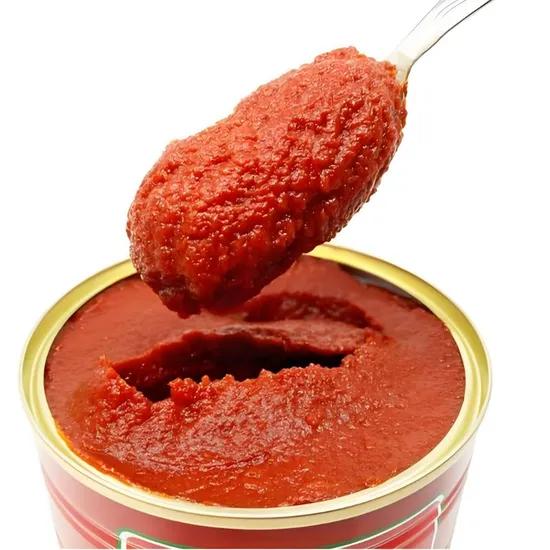
Tomato paste is a concentrated tomato product made by processing tomatoes and removing part of their water content. It is widely used in sauces, soups, ready-to-eat foods, canned products, and other processed foods.
Industrial tomato paste typically has a soluble solids content of approximately 28–36°Brix, depending on the intended application and customer specifications.
Main Processing Steps
Washing and sorting fresh tomatoes.
Crushing the tomatoes, using either hot-break or cold-break processing depending on the product requirements.
Pulping and refining to remove tomato skins and seeds.
Preheating and performing other necessary pretreatment steps.
Concentrating the tomato juice or pulp using vacuum evaporation equipment.
Applying appropriate thermal processing and using a suitable filling system according to the product and packaging requirements.
Main Equipment
Tomato washing and sorting system
Tomato crusher
Preheater
Pulping and refining equipment
Vacuum evaporation system
Thermal processing equipment
Hot-filling or aseptic filling system, selected according to the product and packaging requirements
2. Tomato Purée
Tomato purée is a tomato product with a smooth or semi-smooth, puréed texture. Compared with tomato paste, it generally contains more water and has a lower concentration. However, definitions and product specifications for tomato purée may vary across countries and markets.
Tomato purée is widely used in soups, sauces, prepared foods, and as a raw material for further food processing.
Main Processing Steps
Washing and sorting tomatoes.
Crushing the tomatoes.
Pulping and refining.
Screening and adjusting the consistency when necessary.
Thermal processing.
Filling and sealing.
Main Equipment
Tomato washing machine
Tomato crusher
Pulping machine
Refining screens
Transfer pumps and storage tanks
Thermal processing system
Filling machine
Sealing equipment
Equipment Selection Considerations
A tomato purée production line does not necessarily require a vacuum evaporation system. If the customer needs ordinary tomato purée rather than highly concentrated tomato paste, crushing, pulping, refining, and appropriate thermal processing may be sufficient.
Equipment configuration should be determined by the required texture, solids content, production capacity, and final packaging format.
3. Tomato Ketchup
Tomato ketchup is a seasoned tomato condiment generally made from tomato purée, tomato paste, or other suitable tomato ingredients. Depending on the recipe and applicable product standards, ingredients such as vinegar, sugar, salt, spices, and other permitted additives may be included.
Unlike plain tomato purée or tomato paste, ketchup production requires formulation and mixing to achieve the desired flavor, color, consistency, and stability.
Main Processing Steps
Prepare tomato paste or tomato purée.
Weigh and prepare the other ingredients.
Mix the ingredients according to the formulation.
Heat and cook the mixture as required by the recipe.
Apply high-shear mixing or homogenization when necessary.
Carry out appropriate thermal processing and filling.
Seal the containers and apply any additional necessary, validated processing steps required by the product and packaging system.
Main Equipment
Ingredient preparation and weighing system
Mixing tanks equipped with suitable agitators
Heating or cooking system
High-shear mixer or homogenizer, when required
Transfer pumps
Filling machine
Capping or sealing machine
Equipment Selection Considerations
The mixing system must be suitable for the ketchup formulation and viscosity. Some recipes can be processed using conventional mixing equipment, while others may require additional dispersion or homogenization.
The appropriate filling method depends on product viscosity, filling temperature, container type, and filling accuracy requirements.
4. Pasta Sauce and Tomato-Based Cooking Sauce
Pasta sauces and other tomato-based cooking sauces are formulated products that may contain onions, garlic, herbs, vegetables, edible oils, spices, or other ingredients.
Some products have a smooth consistency, while others retain clearly visible vegetable pieces. These differences directly affect equipment selection.
Main Processing Steps
Prepare tomato purée or tomato paste.
Wash, peel, cut, or otherwise process additional ingredients as needed.
Weigh the ingredients and prepare the formulation.
Mix and cook the ingredients.
Adjust the product texture when necessary.
Fill and seal the containers.
Apply a validated thermal processing method or another appropriate food preservation process.
Main Equipment
Ingredient washing and preparation equipment
Vegetable cutting equipment, if required
Mixing and cooking tanks
Agitators suitable for the product
Heating system
Transfer pumps
Filling and sealing equipment
Thermal processing equipment, when required
Equipment Selection Considerations
The main challenge in pasta sauce production is maintaining consistent flavor and ingredient distribution while preserving the required viscosity and texture.
For sauces containing visible vegetable pieces, the agitators, transfer pumps, pipelines, and filling system must be suitable for handling particulate materials without excessively damaging the pieces.
High-shear mixing is not suitable for every pasta sauce formulation because excessive shear may break down vegetable pieces that need to remain intact.
5. Tomato Juice
Tomato juice is a liquid tomato product intended for drinking or use as an ingredient in food processing. Depending on the desired product characteristics, it can be produced through juice extraction or tomato pulping.
The production line should be designed according to the target product’s flavor, texture, consistency, and shelf-life requirements.
Main Processing Steps
Washing and sorting tomatoes.
Crushing the tomatoes.
Extracting the juice or pulping the tomatoes.
Screening and adjusting the consistency.
Deaeration or homogenization, when necessary.
Thermal processing.
Filling and sealing.
Main Equipment
Tomato washing system
Tomato crusher
Juice extractor or pulping machine
Screening equipment
Deaerator or homogenizer, when required
Thermal processing system
Filling machine
Equipment Selection Considerations
The desired consistency determines how much tomato pulp should be retained and whether additional solids removal is necessary.
For some products, deaeration and homogenization can help improve product characteristics. However, the need for these machines should be determined by the product specifications and actual processing objectives rather than assumed for every production line.
6. Diced Tomatoes and Whole Peeled Tomatoes
Unlike tomato paste and tomato purée, diced tomatoes and whole peeled tomatoes must retain as much of their original physical structure as possible.
Diced tomatoes require cutting the fruit into relatively uniform pieces. Whole peeled tomatoes require removing the skin while preserving the integrity and shape of the fruit.
These products are widely used in canned foods, pizza toppings, food-service supply chains, and industrial food processing.
Main Processing Steps
Diced Tomato Processing:
Washing and sorting.
Peeling, if required.
Dicing the tomatoes.
Inspection and grading.
Filling the packaging containers.
Adding covering liquid according to the product formulation.
Sealing and applying a validated thermal processing method.
Whole Peeled Tomato Processing:
Washing and sorting.
Pretreatment before peeling.
Removing the tomato skins.
Inspection and grading.
Filling the packaging containers.
Adding covering liquid when required.
Sealing and applying a validated thermal processing method.
Main Equipment
Tomato washing machine
Peeling system, when required
Tomato dicing machine
Inspection conveyor
Filling equipment
Can seamer for metal cans or other suitable sealing equipment
Retort or another validated thermal processing system, selected according to the packaging and process design
Equipment Selection Considerations
The main objective is to preserve the shape and texture of the tomatoes. Cutting equipment, conveying systems, and filling machines must meet the size and shape requirements of the target product.
The final thermal processing method must be designed and validated according to the product characteristics, container type, and intended storage conditions.